


Motion in Frame: The Divergent Visions of Xavi Bou and nicholas x bent


PHOTOGRAPHS CAPTURE A MOMENT IN TIME, an instant frozen in perpetuity. “Still life,” if you will.
Movement is only ever implied. Take, for example, a blur indicating the path an object has travelled, like an indistinct figure crossing a room. Or a composition that directs your eye to follow a trajectory, like triangles converging on the horizon. In many cases, our lived experiences inform our perception of motion — when we see an image of the ocean, we can sense it undulating and crashing against rocks.
However, there are two artists who go beyond typical methods of showing movement within photography — Xavi Bou and nicholas x bent. For them, movement is both the content and the method.

The Suspended Birds of Xavi Bou
A large black cloud creeps in from the top right of Xavi Bou’s “Ornithography #238.” It appears as layers of graphite scribbles, but beneath the bulbous mass, a curious subtle wave ascends from left to right, resembling more measured mark making.
These are not pencil drawings at all, but photographs of birds in flight. Each line is composed from hundreds of stills of a single feathered flyer, following its trajectory through the air. The ominous cloud is the overlapping routes of a murmuration of starlings as they compress their group formation in defence from the peregrine falcon attacking from below, as shown in the wavy line.
Using a 4K cinema camera, Xavi records birds in slow motion to make this and other images in his Ornithographies series. Each frame of the video is a still shot, which the Spanish photographer layers digitally to create his compositions. “I’m not discovering new species,” he says, “I’m showing common species in a new way.”

In “Ornithography #151,” you get a similar graphite-like cloud of starlings, this one with the frenzied energy of a tornado. “Ornithography #08” is more calm, with four softly curving waves — akin to the falcon’s pathway — suspended against a soft blue-and-yellow sunset sky. In Ornithographies #194 and #243, the flight paths are more ribbon-like, floating among the clouds.
Each frame captures the bird, frozen, suspended in the sky, and when multiples are compiled into a single image, there’s no blur. Each wing position is there, each point along the flight path plotted out. It’s not what we’re used to seeing in avian photography.
“Why is wildlife always represented in the same way?” asks Xavi, referring to the vibrant, highly detailed and technical nature photography that’s more typical. “In the arts, it’s common to ask about how we represent society, people, gender — how we represent many things. But I haven’t seen another way to represent nature in photography.”
His approach is highly technical and scientific, yet in stitching together multiple images into one, Xavi’s birds become lyrical and expressive. “It’s reality — I’m just changing the perception of time,” he says. It captures the unseen geometry of movement in nature.
The Haunting Trees of nicolas x bent
nicholas x bent, on the other hand, uses movement in nature to explore psychological and emotional turbulence.
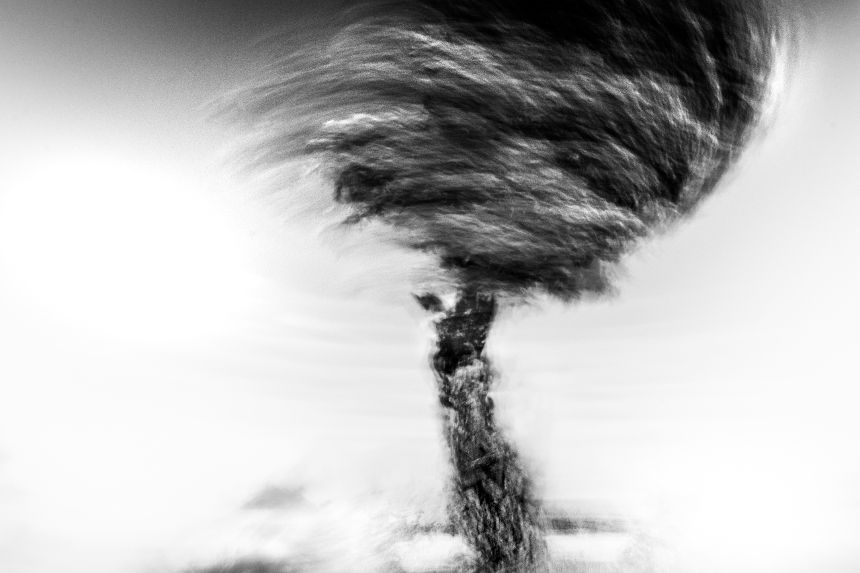
In his work, twisted branches and blurred leaves in black and white evoke chaos and fear. Your eyes struggle to bring into focus the trees and landscapes that he photographs, creating disorientation and discomfort. “These things are living, breathing entities,” says nicholas. “When you diffuse them in this fashion, they become something different. You feel like limbs are going to reach towards you.” These are the trees of nightmares.
To achieve his emotive, charcoal-sketch–like photographs, nicholas relies on long exposures and in-camera movement (ICM). Keeping his subject within his viewfinder as he leaves the shutter open, he moves around it, sometimes on foot and sometimes in a car, on skis, or riding a snowmobile. “I’m able to hold the subject and deform the subject at the same time,” he says. “It gives that same emotional, visual connection that I had as a child looking at the old trees on the islands in Georgian Bay.”
Growing up in Northern Ontario during an era of intense mining, nicholas is attuned to the loss of nature to industry, and it underlies much of his work. His Ex Cathedra series addresses micro logging, for example, while his Marginalia series tackles industrial farming.
Yet for nicholas, these questions of land use parallel questions of humanity and how we treat each other.
Marginalia’s gnarled trees sit along the borders of industrial farm fields — small pieces of wild left on the sidelines to make way for profits. Just as the trees are pushed into ever-smaller areas to make way for homogenized landscapes, there is little room left for people’s individualism within current systems. “The more you marginalize anything, the more abstract they’ll become,” says nicholas. “Boundaries are being forced upon them.”
The movement in nicholas’ photographs conveys anguish and loss.

The Emotion of Movement
Both Xavi and nicholas challenge traditional still photography by focusing on movement — but their visions couldn’t be more different.
Technique is central to their work but doesn’t define it. Through movement, they introduce us to a new way to look at and understand our world.
While the two artists manipulate time and space, Xavi seeks harmony in motion, and nicholas confronts its chaos. Together, their work reveals the power of photography to visualize time through motion, not as a frozen instant, but as a dynamic and deeply expressive force.
This feature was produced with the support of The Cardinal Gallery, and premiered in 2025 in issue #75, The MOVEMENT edition.

The Cardinal Gallery is a creative exhibition space with a focus on showing fine art photography as well as providing an inviting event venue for the arts community.


